GHRP-6 Acetate
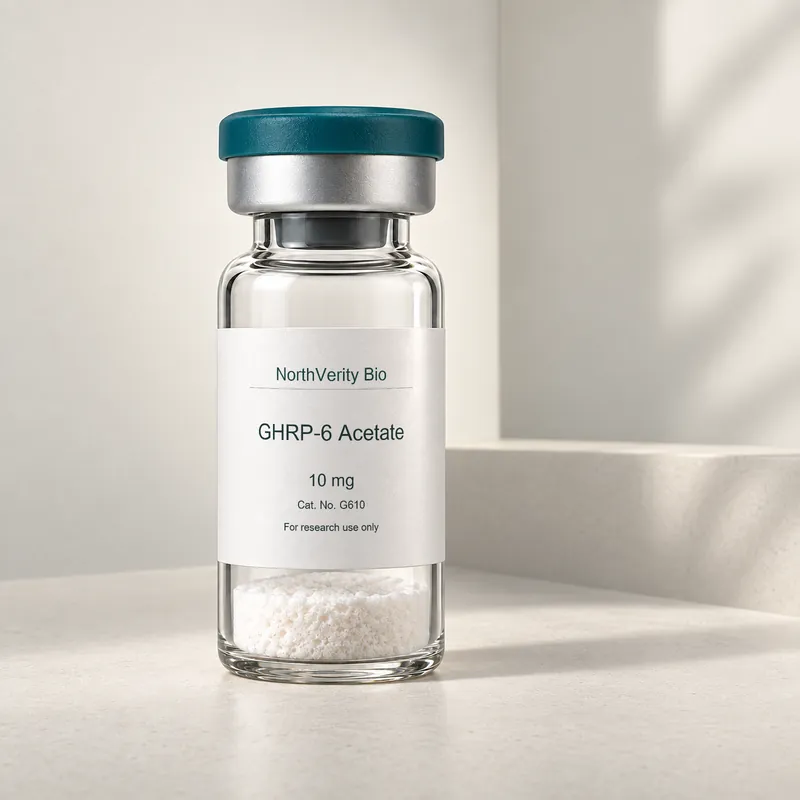
10 mg × 10 vials
For laboratory procurement
- Catalog number
- G610
- Listed specification
- 10 mg
- Vials per pack
- 10 vials
- Test reports
- No report published for this SKU
- Current supply lot
- Lot documents with your quote
Compound profile
GHRP-6 is a synthetic amidated hexapeptide with D-tryptophan and D-phenylalanine, distinct from the GHRH peptide family.
Identity
- Sequence
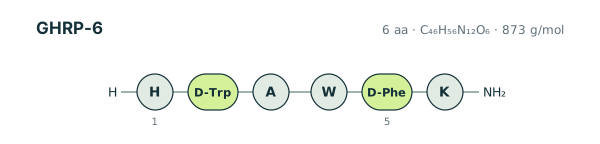
H-H[D-Trp]AW[D-Phe]K-NH2- Residues
- 6
- Molecular formula
- C46H56N12O6
- Average molecular weight
- 873 g/mol
- Monoisotopic mass (calculated)
- 872.4446 Da
- CAS number
- 87616-84-0
- PubChem CID
- 9919153
- Strengths
- 5–10 mg
- Other names
- Growth hormone releasing hexapeptide · Hexapeptide-2
The selected PubChem record specifies D-Trp2 and D-Phe5; a name lookup can also return a record with unspecified stereochemistry. Values describe the free peptide, excluding the catalog’s acetate counterion. No separate UniProt identity was verified; the residue sequence represents the structure without atom coordinates, SMILES or blend components.
Identity data from: PubChem CID 9919153
Research overview
GHRP-6 has the sequence His-D-Trp-Ala-Trp-D-Phe-Lys-NH2. It is a synthetic six-residue peptide, with D stereochemistry at the second and fifth positions and an amidated C terminus. Its sequence differs from the hypothalamic GHRH family. An early experiment with dispersed rat pituitary cells used this exact hexapeptide to investigate how its receptor-linked secretory response differed from the response to GHRH. Peptide identity and the cell preparation are both explicit parts of that comparison [1].
In the perifusion experiment, the investigators observed different response patterns when cells were exposed sequentially to GHRP-6 and GHRH. Desensitisation to one signal did not remove the response to the other, supporting distinct receptor-linked messenger systems in that preparation. Somatostatin was also examined as a modulator of the measured secretion. The study thus addressed pathway separation and cellular responsiveness in a rat pituitary model rather than assigning every short secretagogue the same signalling behaviour [1].
A later study compared GHRP-6 with GHRP-2 in primary rat pituitary cells. Reciprocal desensitisation and antagonist experiments supported a shared receptor mechanism for these two structurally different hexapeptides. Read together, the papers separate the short-peptide comparison from the GHRH comparison: a shared response between GHRP-2 and GHRP-6 in one assay does not erase their different residue identities or establish equivalence with GHRH [2].
Laboratory storage and handling
Store sealed peptide vials under the temperature conditions stated in the lot documentation, protected from light and moisture. Let a cold vial reach room temperature before opening to limit condensation. Avoid repeated freezing and thawing of laboratory stocks, record storage history and the lot identifier, and use standard laboratory protective equipment. Chemical modifications and counterions should be checked against the supplied analytical description.
Questions about GHRP-6
Which residues have D stereochemistry?
The selected molecular identity places D-Trp at residue 2 and D-Phe at residue 5. The remaining named amino acids are represented in their standard configuration.
Why compare GHRP-6 with GHRH in cell assays?
The perifused rat-cell study used desensitisation patterns to distinguish receptor-linked messenger systems. Cells unresponsive to one signal could still respond to the other [1].
Is GHRP-6 structurally identical to GHRP-2?
No. The peptides have different residues despite shared responses in the cited primary rat pituitary-cell comparison. The authors examined reciprocal desensitisation and antagonist sensitivity [2].
References
- Desensitization studies using perifused rat pituitary cells show that growth hormone-releasing hormone and His-D-Trp-Ala-Trp-D-Phe-Lys-NH2 stimulate growth hormone release through distinct receptor sites. J Endocrinol 1991. PMID 1674284
- Growth hormone releasing peptides: a comparison of the growth hormone releasing activities of GHRP-2 and GHRP-6 in rat primary pituitary cells. Life Sci 1997. PMID 9096259
Identity data checked on 2026-10-03. Literature summaries describe published research models and are not specifications of any product lot.
Compare specifications
2 catalog entriesTest reports
Third-party testNo sample report is published for this item yet. Ask for the documents for the exact lot in your quote.
Ask for the documents for the exact lot in your quote. A report describes only the batch it tested, so check that its lot number matches the lot you receive.
Request current lot documentsB2B procurement
Packaging
Catalog illustration—not an actual packaging photo.
Shipping, payment and lot documents
Ships from China worldwide in 3–15 days, depending on region. Payment by PayPal, USDT, Bitcoin, Alipay, Western Union or bank wire (T/T).
Shipping, payment and lot document detailsRequest a quote
Prices are not listed on the site. Send your quote list and we confirm price, availability and delivery in a written quote.