Testagen
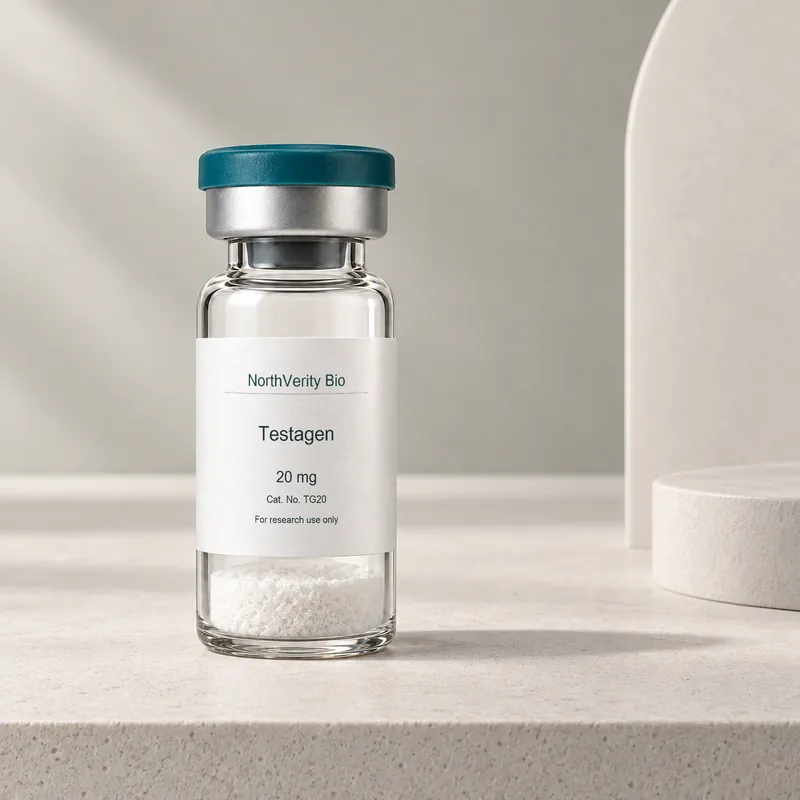
20 mg × 10 vials
For laboratory procurement
- Catalog number
- TG20
- Listed specification
- 20 mg
- Vials per pack
- 10 vials
- Test reports
- No report published for this SKU
- Current supply lot
- Lot documents with your quote
Compound profile
Testagen is the Lys-Glu-Asp-Gly tetrapeptide examined in nucleic-acid interaction experiments and copper-surface chemistry.
Identity
- Sequence
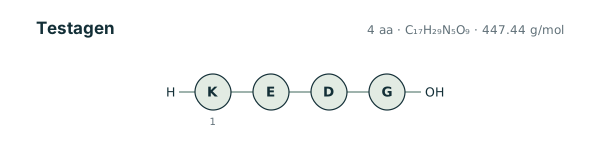
H-KEDG-OH- Residues
- 4
- Molecular formula
- C17H29N5O9
- Average molecular weight
- 447.44 g/mol
- Monoisotopic mass (calculated)
- 447.1965 Da
- CAS number
- Not recorded
Formula and average mass are computed from the verified free KEDG sequence. CAS, PubChem CID and UniProt were not verified; SMILES and 2D coordinates were not transcribed. Biological literature is limited and mostly from one group; the copper-surface study provides an independent chemistry context.
Identity data from: PubMed PMID 40807317: H-Lys-Glu-Asp-Gly-OH identity · computed from the sequence
Research overview
Testagen is the four-residue sequence Lys-Glu-Asp-Gly, abbreviated KEDG. The terminal glycine differentiates it from KEDP, while the first three residues are KED. A cell-based paper explicitly names Testagen and prints the sequence; the later chemistry article specifies the free H-Lys-Glu-Asp-Gly-OH molecule. These identities permit a sequence-based formula calculation, but the short name does not establish a receptor or an organ-selective mechanism. The two references examine very different settings and must be interpreted within their own designs [1][2].
In the biological study, fluorescence-labelled Testagen was examined in HeLa cells alongside other short peptides. The investigators observed cellular and nuclear fluorescence and measured quenching with labelled oligonucleotides and DNA complexes. The experiment separates localisation of tagged material from interactions measured in cell-free nucleic-acid systems; fluorescence does not alone establish a downstream regulatory pathway [1]. The independent chemistry study investigated KEDG adsorption on copper surfaces in a saline environment using electrochemical measurements, optical microscopy and SEM/EDS. Density-functional calculations and Monte Carlo simulation were also used to examine possible adsorption configurations. These are material-surface observations and computational models, not measurements of a biological organ. They expand the experimental contexts in which KEDG appears without validating biological claims associated with its name [2].
The biological evidence remains limited and mostly linked to one originating group. The surface-chemistry paper is an independent line of work. Nuclear fluorescence, oligonucleotide quenching and copper adsorption should remain separate observations rather than being joined into a common mechanism [1][2].
Laboratory storage and handling
Follow the storage conditions stated in the documentation supplied with the lot. Keep the sealed vial cold, dry and protected from light. Let it reach room temperature before opening to reduce moisture condensation on the material. Avoid repeated freezing and thawing of laboratory stocks, record lot identifiers with experiments and wear standard laboratory protective equipment. Published biological observations do not establish storage stability for a particular lot.
Questions about Testagen
What sequence does this profile describe?
Testagen is the free peptide Lys-Glu-Asp-Gly, written KEDG in one-letter notation. The identity record specifies an unmodified N terminus and a free carboxyl terminus; a salt form would be a separate chemical description.
Which experimental systems appear in the cited work?
The biological paper uses HeLa cells and nucleic-acid fluorescence assays; the chemistry paper uses copper surfaces, electrochemistry, microscopy and simulation. A surface interaction cannot be substituted for a cellular pathway measurement [1][2].
References
- Penetration of short fluorescence-labeled peptides into the nucleus in HeLa cells and in vitro specific interaction of the peptides with deoxyribooligonucleotides and DNA. Biochemistry (Mosc) 2011. PMID 22117547
- The Inhibitory Effect and Adsorption Properties of Testagen Peptide on Copper Surfaces in Saline Environments: An Experimental and Computational Study. Molecules 2025. PMID 40807317
Identity data checked on 2026-10-03. Literature summaries describe published research models and are not specifications of any product lot.
Compare specifications
1 catalog entryTest reports
Third-party testNo sample report is published for this item yet. Ask for the documents for the exact lot in your quote.
Ask for the documents for the exact lot in your quote. A report describes only the batch it tested, so check that its lot number matches the lot you receive.
Request current lot documentsB2B procurement
Packaging
Catalog illustration—not an actual packaging photo.
Shipping, payment and lot documents
Ships from China worldwide in 3–15 days, depending on region. Payment by PayPal, USDT, Bitcoin, Alipay, Western Union or bank wire (T/T).
Shipping, payment and lot document detailsRequest a quote
Prices are not listed on the site. Send your quote list and we confirm price, availability and delivery in a written quote.