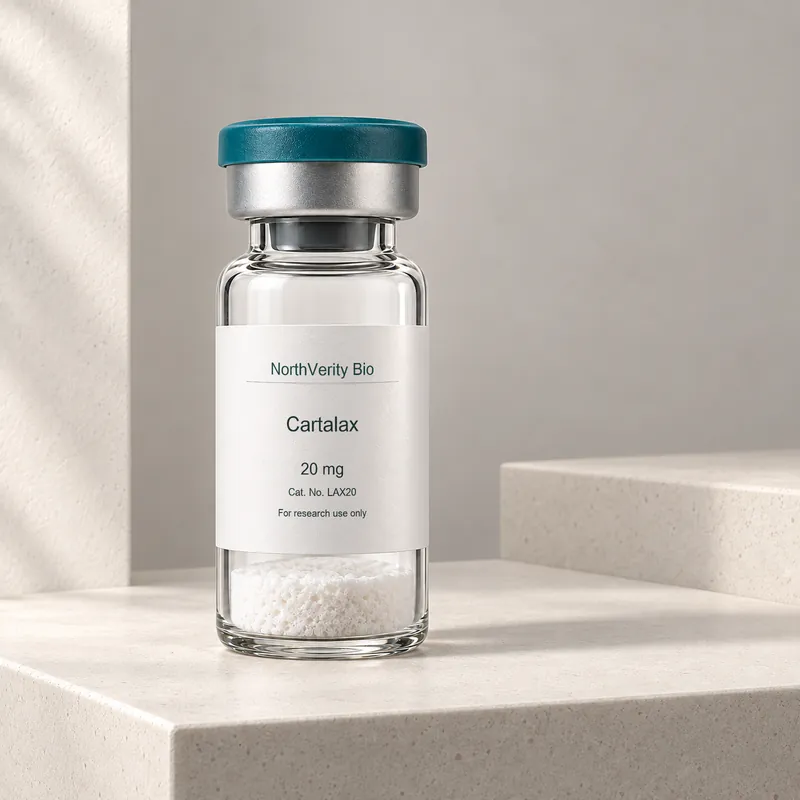
Cartalax
20 mg × 10 vials
For laboratory procurement
- Catalog number
- LAX20
- Listed specification
- 20 mg
- Vials per pack
- 10 vials
- Test reports
- No report published for this SKU
- Current supply lot
- Lot documents with your quote
Compound profile
Cartalax is the synthetic Ala-Glu-Asp tripeptide appearing in fibroblast protein-expression and peptide–DNA docking studies.
Identity
- Sequence
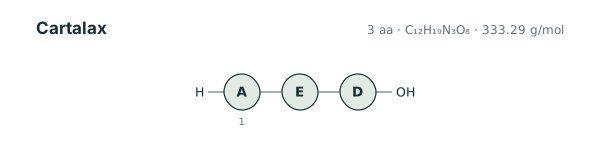
H-AED-OH- Residues
- 3
- Molecular formula
- C12H19N3O8
- Average molecular weight
- 333.29 g/mol
- Monoisotopic mass (calculated)
- 333.1172 Da
- CAS number
- 85806-95-7
- PubChem CID
- 87815447
- Other names
- AED
The structure and biologic notation identify free AED. A conflicting PubChem synonym beginning with Asp was not selected. Literature is limited and mainly from one group. UniProt is inapplicable; SMILES and 2D coordinates were not transcribed.
Identity data from: PubChem CID 87815447: properties, biologic line notation and synonyms
Research overview
Cartalax corresponds to the three-residue peptide Ala-Glu-Asp, written AED. The alanine at its amino end distinguishes it from Lys-Glu-Asp, while the absence of a fourth residue distinguishes AED from related tetrapeptides. The verified record describes a free, linear peptide. In the cited fibroblast paper the sequence code AED, rather than the short catalog name, identifies the material among a panel of peptides; this sequence-level distinction is necessary when reading its individual findings [1].
Investigators examined AED alongside KE, KED and AEDG in skin fibroblast cultures. Immunofluorescent confocal microscopy was used to assess Ki-67, CD98hc, caspase-3 and MMP-9, placing proliferation-associated signals, apoptosis markers and extracellular-matrix measurements in the same experimental setting. Reported expression changes are observations within those cultured cells, not evidence that every peptide in the panel shares an identical pathway [1]. A separate computational study constructed docking models for nineteen short peptides and DNA. For AED it proposed interaction with an acct nucleotide sequence. Docking provides a spatial hypothesis about a possible contact; it does not directly measure binding in an intact cell, nor establish that the modeled site determines the fibroblast response [2].
The cited biological literature is limited and mainly comes from one connected research group. These experiments describe particular cell or tissue systems. Their readouts do not establish a general mechanism across organs, and independent replication remains important when assessing the proposed molecular interactions [1][2].
Laboratory storage and handling
Follow the storage conditions stated in the documentation supplied with the lot. Keep the sealed vial cold, dry and protected from light. Let it reach room temperature before opening to reduce moisture condensation on the material. Avoid repeated freezing and thawing of laboratory stocks, record lot identifiers with experiments and wear standard laboratory protective equipment. Published biological observations do not establish storage stability for a particular lot.
Questions about Cartalax
What sequence does this profile describe?
Cartalax is the free peptide Ala-Glu-Asp, written AED in one-letter notation. The identity record specifies an unmodified N terminus and a free carboxyl terminus; a salt form would be a separate chemical description.
Which experimental systems appear in the cited work?
The references examine skin fibroblast cultures and computational peptide–DNA docking. Protein-marker microscopy and spatial simulation answer different questions, so an inferred docking contact should not be presented as a measured cellular mechanism [1][2].
How should the evidence be interpreted?
The papers provide observations in defined experimental models and largely share an originating research network. They do not establish that the same molecular response occurs in unrelated systems. Independent comparisons and careful identification of the material remain necessary.
References
- Peptide Regulation of Skin Fibroblast Functions during Their Aging In Vitro. Bull Exp Biol Med 2016. PMID 27259496
- Short Peptides Regulate Gene Expression. Bull Exp Biol Med 2016. PMID 27909961
Identity data checked on 2026-10-03. Literature summaries describe published research models and are not specifications of any product lot.
Compare specifications
1 catalog entryTest reports
Third-party testNo sample report is published for this item yet. Ask for the documents for the exact lot in your quote.
Ask for the documents for the exact lot in your quote. A report describes only the batch it tested, so check that its lot number matches the lot you receive.
Request current lot documentsB2B procurement
Packaging
Catalog illustration—not an actual packaging photo.
Shipping, payment and lot documents
Ships from China worldwide in 3–15 days, depending on region. Payment by PayPal, USDT, Bitcoin, Alipay, Western Union or bank wire (T/T).
Shipping, payment and lot document detailsRequest a quote
Prices are not listed on the site. Send your quote list and we confirm price, availability and delivery in a written quote.