VIP5
5 mg × 10 vials
For laboratory procurement
- Catalog number
- VIP5
- Listed specification
- 5 mg
- Vials per pack
- 10 vials
- Test reports
- No report published for this SKU
- Current supply lot
- Lot documents with your quote
Compound profile
VIP is an amidated 28-residue peptide processed from a larger precursor and studied as a ligand of VPAC receptors.
Identity
- Sequence
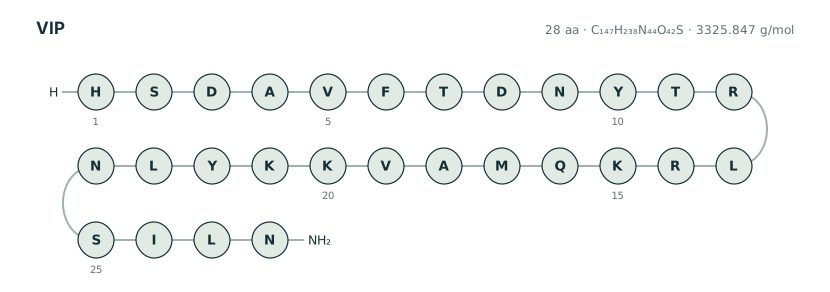
H-HSDAVFTDNYTRLRKQMAVKKYLNSILN-NH2- Residues
- 28
- Molecular formula
- C147H238N44O42S
- Average molecular weight
- 3325.847 g/mol
- Monoisotopic mass (calculated)
- 3323.7561 Da
- CAS number
- Not recorded
- Strengths
- 5–10 mg
- Other names
- Vasoactive intestinal peptide
The sequence follows the amidated peptide in UniProt P01282. Opened PubChem name records described the free-acid form, so their CID and CAS were not assigned here. Formula and average weight were computed from the sourced sequence. SMILES was not verified.
Identity data from: UniProtKB P01282 · computed from the sequence
Research overview
VIP is vasoactive intestinal peptide, a 28-residue peptide whose C-terminal asparagine is amidated. UniProt identifies it within a larger precursor that also contains other processed peptides. Receptor research describes VIP recognition by VPAC1 and VPAC2, members of the class B G-protein-coupled receptor family. The first cited review examines how the extracellular receptor domain contributes to ligand binding and how receptor activation connects to adenylyl cyclase. It brings together site-directed mutagenesis, photoaffinity labeling, nuclear magnetic resonance and molecular modeling. These methods address different aspects of the interaction between a peptide ligand and the receptor that recognizes it [1].
A subsequent structural study determined active receptor complexes by cryo-electron microscopy, including a VIP–VPAC1 receptor complex associated with Gs. Comparison with PACAP-containing complexes and molecular-dynamics analyses examined ligand binding and receptor selectivity. The resulting structures describe the arrangements captured in those experimental complexes, while simulations explore possible motions around them. This combination supplies a molecular framework for comparing related peptide–receptor systems. It does not mean that all members of the receptor family recognize each ligand in exactly the same way, or that precursor peptides and mature amidated VIP have identical molecular identities [2].
Laboratory storage and handling
Keep the sealed vial cold, dry and protected from light, following the conditions in the documentation supplied with the lot. Let the vial reach room temperature before opening to limit moisture condensation. Avoid repeated freezing and thawing of laboratory stocks. Record the lot identifier and the material form with each experiment, and use standard laboratory protective equipment.
Questions about VIP
Which terminal form is described here?
The sequence describes mature VIP with an amidated C-terminal asparagine, as annotated in UniProt P01282. It is distinct from the corresponding free-acid peptide.
Which receptor subtypes are discussed?
The review discusses the VPAC1 and VPAC2 subtypes within class B G-protein-coupled receptors, emphasizing ligand recognition, signaling and receptor-associated proteins [1].
What did the structural study examine?
The structural work examined active peptide–receptor complexes, including VIP with VPAC1 and Gs, using cryo-electron microscopy together with comparative analyses and molecular dynamics [2].
References
- VPAC receptors: structure, molecular pharmacology and interaction with accessory proteins. Br J Pharmacol 2012. PMID 21951273
- Understanding VPAC receptor family peptide binding and selectivity. Nat Commun 2022. PMID 36385145
Identity data checked on 2026-10-03. Literature summaries describe published research models and are not specifications of any product lot.
Compare specifications
2 catalog entriesTest reports
Third-party testNo sample report is published for this item yet. Ask for the documents for the exact lot in your quote.
Ask for the documents for the exact lot in your quote. A report describes only the batch it tested, so check that its lot number matches the lot you receive.
Request current lot documentsB2B procurement
Packaging
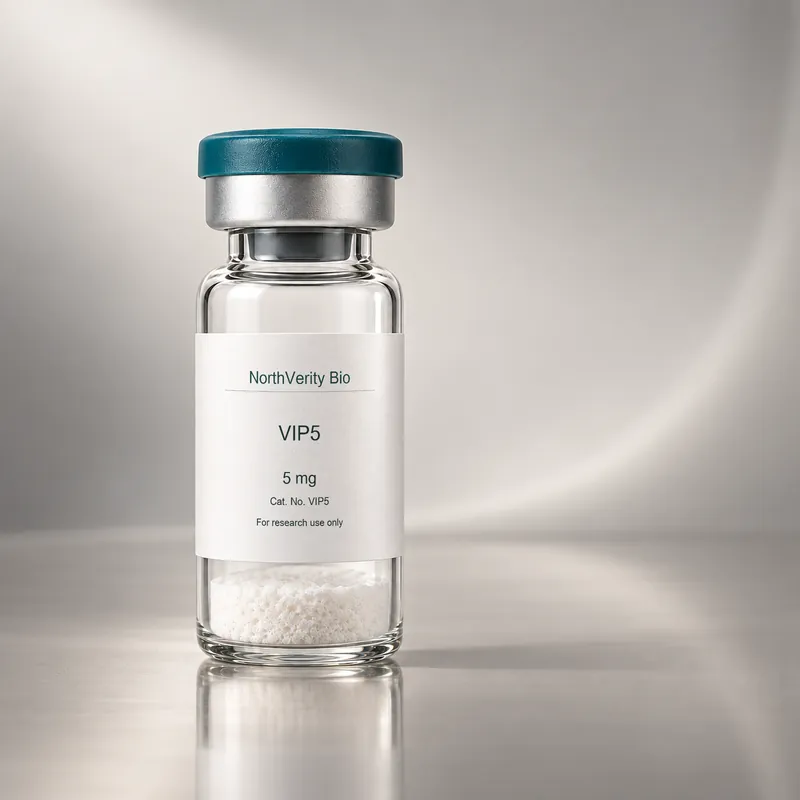
Catalog illustration—not an actual packaging photo.
Shipping, payment and lot documents
Ships from China worldwide in 3–15 days, depending on region. Payment by PayPal, USDT, Bitcoin, Alipay, Western Union or bank wire (T/T).
Shipping, payment and lot document detailsRequest a quote
Prices are not listed on the site. Send your quote list and we confirm price, availability and delivery in a written quote.